Intel Barcelona Hub

Intel Barcelona Hub

Intel has turned Barcelona into a strategic cornerstone for its European strategy, focusing on two major high-tech pillars: Next-Generation Microchips and Autonomous Driving.

1. The Semiconductor Design Center (Zetta-Scale)

In collaboration with the Barcelona Supercomputing Center (BSC), Intel has invested €400 million over ten years to create a laboratory for high-performance computing.

  • The Mission: Designing Zetta-scale processors. These are chips 1,000 times faster than today’s most powerful supercomputers.
  • RISC-V Technology: The hub is a pioneer in using RISC-V, an open-source architecture that aims to reduce Europe’s dependence on proprietary American or British chip technologies (like ARM or x86).
  • Sovereignty: This project is part of the “PERTE Chip” initiative, aimed at making the EU a global leader in semiconductor manufacturing.

2. Mobileye (Autonomous Driving Hub)

Intel’s subsidiary Mobileye (the world leader in computer vision for cars) also considers Barcelona a key “living lab.”

  • Autonomous Fleets: Mobileye uses Barcelona’s streets to test its Robotaxi technology and autonomous mapping (REM).
  • Infrastructure: They work closely with the city council to integrate AI into traffic management and urban safety.
BSC

BSC Barcelona Supercomputing Center

The Barcelona Supercomputing Center (BSC-CNS) is Spain’s national supercomputing facility and a leading research institution in Europe. Established in 2005, it is most famous for housing the MareNostrum supercomputer.

A Unique Setting: High-Tech in a Chapel

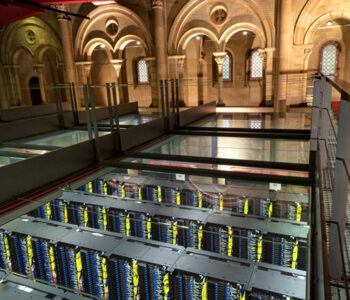
One of the BSC’s most striking features is its location. The supercomputer is housed inside the Torre Girona, a 19th-century de-consecrated chapel on the Campus Nord of the Polytechnic University of Catalonia (UPC). Seeing the glowing glass box of MareNostrum inside the classic stone arches of the chapel makes it one of the most beautiful data centers in the world.

MareNostrum 5

The latest iteration, MareNostrum 5, is among the most powerful supercomputers globally. It is designed to support a wide range of scientific fields, with a specific focus on boosting Artificial Intelligence (AI) and European chip technology.

With a team of over 1,300 experts, the center focuses on:

  • Life Sciences: Personalizing medicine and simulating drug interactions.
  • Earth Sciences: Modeling climate change and predicting air quality.
  • Computer Sciences: Designing the next generation of European processors.
  • Engineering: Simulating complex fluid dynamics for aircraft or city infrastructure.
CISCO

Cisco Barcelona Hub

Cisco’s Barcelona Hub is a premier center for innovation and the company’s first Giga-Scale Semiconductor Design Center in the European Union. Located in the 22@ tech district, it serves as a critical node for Cisco’s global engineering and R&D strategy.  

1. The Semiconductor & Chip Design Center

This is one of Cisco’s most ambitious European projects.

  • Mission: It focuses on the design and prototyping of next-generation semiconductors. This initiative is part of the “PERTE Chip” program, aiming to strengthen Europe’s digital sovereignty in the microchip industry.
  • Technology: Teams here work on advanced silicon photonics and high-performance chips that power the world’s most complex data centers and internet infrastructures.

2. Co-Innovation Center (Ca l’Alier).

Cisco also operates a Co-Innovation Center located in a renovated 19th-century factory.

  • Focus: This site is dedicated to Smart Cities, Internet of Things (IoT), and Cybersecurity. It acts as a collaborative space where Cisco engineers work alongside startups, researchers, and public institutions to build urban technology solutions.
  • Strategic Role: It is one of only a handful of such centers globally, focusing on digitizing critical infrastructure and energy efficiency.

The Barcelona sites employ several hundred highly skilled engineers, developers, and data scientists. As with their global operations, English is the primary professional language.