BSC

BSC Barcelona Supercomputing Center

The Barcelona Supercomputing Center (BSC-CNS) is Spain’s national supercomputing facility and a leading research institution in Europe. Established in 2005, it is most famous for housing the MareNostrum supercomputer.

A Unique Setting: High-Tech in a Chapel

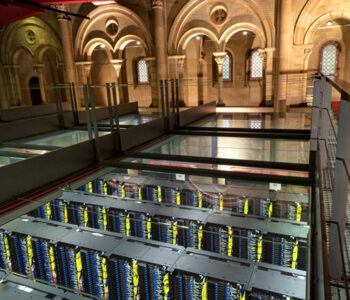
One of the BSC’s most striking features is its location. The supercomputer is housed inside the Torre Girona, a 19th-century de-consecrated chapel on the Campus Nord of the Polytechnic University of Catalonia (UPC). Seeing the glowing glass box of MareNostrum inside the classic stone arches of the chapel makes it one of the most beautiful data centers in the world.

MareNostrum 5

The latest iteration, MareNostrum 5, is among the most powerful supercomputers globally. It is designed to support a wide range of scientific fields, with a specific focus on boosting Artificial Intelligence (AI) and European chip technology.

With a team of over 1,300 experts, the center focuses on:

  • Life Sciences: Personalizing medicine and simulating drug interactions.
  • Earth Sciences: Modeling climate change and predicting air quality.
  • Computer Sciences: Designing the next generation of European processors.
  • Engineering: Simulating complex fluid dynamics for aircraft or city infrastructure.
IDEAL HOTSPOT

IDEAL Digital Arts Center

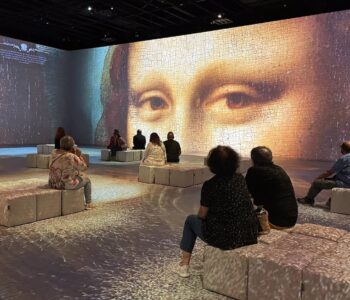
IDEAL Digital Arts Center is a pioneering digital arts center in Barcelona that combines immersive technology, virtual reality, and digital projections to create unique cultural experiences. It serves as a laboratory for digital creation and a space for large-scale immersive exhibitions.

Large-screen immersive rooms, VR (Virtual Reality) areas, and 360-degree projections.

The center has almost 2000 m2 dedicated to the exhibition, production and training of digital immersive arts. The main floor has 1500 m2: 800m2 for large format exhibitions, and also 3 multipurpose spaces to produce diverse acts and experiences.
IDEAL LAB is based on the second floor where there are the offices and the artists in residency space, since IDEAL is also a center focused on developing local talent to create its own productions.

ColoniaGuell HOTSPOT

Colonia Guell Lab

Colònia Güell is a former industrial village located about 20 minutes from Barcelona. Founded in 1890 by entrepreneur Eusebi Güell, it was built to provide a higher quality of life for textile workers and is now a celebrated open-air museum of Catalan Modernisme

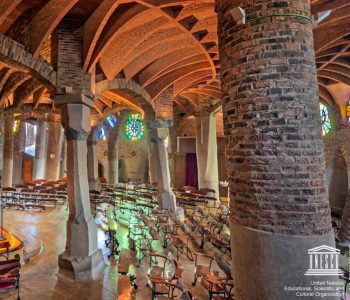
The Gaudí Crypt: a UNESCO World Heritage site. Antoni Gaudí used this church as a “laboratory” to test architectural innovations—such as catenary arches and hyperbolic parabolas—that he would later apply to the Sagrada Família. 

  • Stereostatic Model: Gaudí invented a complex system of hanging strings and weights (poly-funicular model) to calculate the gravity and pressure of arches. By photographing this inverted model, he designed catenary arches that didn’t require external buttresses.
  • Hyperbolic Paraboloids: He was the first to use these warped mathematical shapes in walls and vaults, allowing for curved, organic structures that integrated into the hillside.
  • Material Innovation: He pioneered the use of recycled industrial waste, such as iron slag from the nearby factory and over-fired “waste” bricks, to create textured, cost-effective surfaces. 
ALBA Synchrotron

ALBA synchrotron

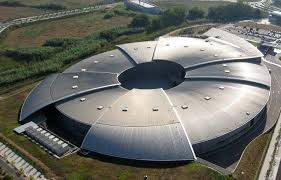
The ALBA Synchrotron is a large research infrastructure, located in Cerdanyola del Vallès (Barcelona). It is a fundamental pillar of the Spanish and European research arena, offering to academic and industrial users a wide variety of state-of-the-art instrumentation.